Tuesday, September 11, 2007

Last Sunday’s Trip: Enoshima Island

Actually it was arif’s plan as to go to Enoshima island. Thanks my friend arif for your effort to identify such a nice island and beach close to our resident. Its just 10mins train travel from shonandai to enoshima beach and island. Wauuu..really small and pretty island I ever seen. This is my first experience walking around the island. The island is natural and piece having temples of budda’s and beautiful sceneries around the beach. We reached at the peak of island and captured several photos of beach and other peculiar food items specially sea foods. We spent our whole day walking around the island


Saturday, September 01, 2007

Flash Back: SIGCOMM-2007 & ocean13 Movie in TOHO Cinemas KYOTO-JAPAN

Yes, I returned back to my palace at ObaSobako Mae after one week conference (SIGCOMM-2007 data communication festival) from Kyoto. The one week stay at prince hotel and conference on ICC was really memorable as well as beneficial for me. I got a chance to talk with all presenters on this conference. I found that almost presenters were from MIT, California, Stanford, Cornel University, catholic university Canada, IIT Kanpur etc etc. The 2nd, 3rd and 4th day presentations were held inside big conference hall. 1st & 5th day presentations were held on F hall.
I am very much thankful to Keiko-san for such a nice opportunity to appear on this world’s top conference related to computer network. During this 5 days conference I met 3 Microsoft Researchers, FreeBSD Developer, CISCO managers and professors form different universities. By the way I became lucky that I got mail-id from almost all presenters. This is my big achievement and experience about to participate in such a conference and acquiring latest information about network/routing from IETF members, Microsoft researchers and professors. What I found that it is really incomparable about the learning technique of Nepal with other countries. Nepalese only learn theory but the most important thing is implementation. How OS can be developed, How routing software can be developed and what are the bugs on OSs and Routing, IPv6 networking and operation etc etc.. these are the major points what I learned in root level from this conference.

Thanks to Conference live broadcasting team (yoko-san, keiko-san, yukie-san, abazh-san, yoo-san, arif-san, dawadi-san, qoo-san…sorry I forgot other names) who worked full day to broadcast and upload videos online. All videos and pdfs of the presentations are available on http://www.soi.wide.ad.jp/project/sigcomm2007/. Anybody can see this videos online by installing VLC on their machine.
Thanks to SIGCOMM vice chairman for providing us two SIGCOMM T-Shirts and Books.

ICC-Kyoto Primises

Sigcomm-2007 Presentation


Audience inside conference hall

funn with SIGCOMM Podium


with Live Broadcasting equipments

Ohh.. I forgot to write about ocean13 movie in TOHO cinemas hall Kyoto. Keiko-san provided us (me and arif) 4 tickets. Actually we can see any film on any hall of Kyoto city from these tickets. But when we got that tickets, we afraid about how to reach to hall. We hadn’t had sufficient knowledge about Kyoto city and traveling on train also. Anyway after getting nice instruction from keiko-san, we reached to TOHO Cinemas hall located near NIJO station. That hall had 7 screens. Different movies were running on 7 screens. Finally we conformed to see OCEAN13 on screen 5. The hall was quite small and nice furnished with fully equipped dolby digital sound system. Ha ha ha how peaceful during watching movie inside the hall. Nobody sounds except movie characters. I remembered, I had watched one hindi movie in jaynepal hall last time in Nepal (5 mnths ago sorry I forgot the name of that movie). When HERO came on the screen then people excited with big clapping. Ha ha ha..that is the difference.

Tuesday, August 28, 2007

Trip to KYOTO-CITY by SHINKANSEN and SIGCOMM-2007 Data Festival in ICC Hall Kyoto

After around two weeks, I am coming back to my blog. Actually I was busy for presentation and practical analysis of OSPF routing in IPV6. fortunately after having presentation on Thursday, I heard that keiko-san was going to bring us to Kyoto city for SIGCOMM-2007 conference. SIGCOMM is the big conference in the world related to data communication and computer networks. It’s a great opportunity for a person who get a chance to present their paper in SIGCOMM.
Finally our trip was set. We had to come to Kyoto by SHINKANSEN, the world’s highest speed bullet train. Actually it was my great opportunity having trip with shinkansen as well as participation on SIGCOMM conference.
We two (Arif and me) had to come to Kyoto by bullet train. We were somehow afraid about whether we loss inside the transit, what could we do?? By the way, its was so easy to reach to the Kyoto city. Bullet train (NOZOMI-SHINKANSEN)!!! 300Km/hr, Wowww I cant imagine how Japanese build such a system/technology. Any way, our trip by bullet train was really memorable. Here is some snap what captured by my camera.
The hotel room was already reserved by funya-san for us. Grand-Prince Hotel, located just in front of the International Conference Hall is one of the highest standard hotels in Kyoto. I became little surprised by seeing the hotel room furnishing and its electronic toilet ha ha..any way we can live on this hotel for 5 days. Can you imagine the price of double bed room per day on this hotel?? Its 20000 yen/24hrs just for living, no any more dinner/breakfast. Lets see the picture of electronic toilet and other snapshots inside the hotel room. Sorry I cant explain the function of this machine, must be kept secret… ha ha ha

with SIGCOMM T-Shirt

Hotel Room


Hotel Premises
Lets come to the conference part. Conference started from 27th august. I am assigned to collect copyright agreement, control the UDL network to SFC and make summary report of the each presenter. I hadn’t had previous knowledge about how to make summary report of the presentation. Another thing, the papers presenting are sometime difficult to understand and also I have to catch up the speaker’s pace. Behind this, I am getting entertainment having inside the big conference hall and getting photos of this conference hall. I completed my 1st days responsibilities successfully. Thanks much keiko-san for providing such opportunity and I also got a T-shirt of SIGCOMM ha ha..

ICC Kyoto


Inside Big-Conference Hall

Shinkansen Gate

Inside Shinkansen


Site seen from Shinkansen


Machine Controlled toilet in Grand prince hotel

Monday, August 06, 2007

Quality Checking of my Camera

i have to check the quality of my camera. so i took several pictures around the SFC and lets see some snapshots:
In SFC

from left: Arif, Abazh and Me


Street at Night


AI3 and SOI Control Room


baburd, infront of Murai Lab (Delta Building)


Murai Lab Working Environment


My Working Table


My Dinner: Rice, Chicken, Fruits


SFC, KEIO University

Sunday, August 05, 2007

I never forget that day when we were in Akihabara.

Yesterday, first holiday of the week in Japan so called Saturday. Abazh-san, Dedy-san, Arif-san and me reached YOKOHAMA terminal first around 1 PM. We were just directed to the famous electronic city of Tokyo Japan called Akihabara. Every body has plan as what to buy after reaching Akihabara. Actually we all are foreigner. Abazh, Arif and Dedy are from Indonesia and me from Nepal. Of course we all are not familiar with different places of Japan, even not familiar with Akihabara. We reached to the destination around 2 PM by passing several terminals in train. I would loss if I will be alone only inside the train terminal. How big are the terminals, faced in all fourth directions, can’t predict which direction to go? Dedy has a printed map of the city downloaded from Google.

Though we had map, its really difficult to identify the shops. Unfortunately every one had to purchase their items from different shop. Akihabara is a big city with huge buildings and show rooms of every electronic goods. We walked around the city more and more to find the places. It was a good chance to me to have site scene over there means I got advantage due to our unfamiliarity with that area.Ohhhh..i can’t imagine, what a big city with huge buildings and billions of items like laptop, Ipod, digital camera, PCs etc…after rounding about three hours we found out the camera shop what I had to purchase. I already set my mind to buy a camera with model no S6000FD of FujiFilm company. After having long queue finally I got succeed to buy my camera. It costs about Thirty-Seven thousands including a 1GB Memory chip.

My Camera
We walked around several shops of laptop. Dedy had to buy a laptop. He had model number with him but it was difficult to find out the shop having that model number. I became surprised by seeing store of laptops and cameras. It is billion in quantity.

No matter you can choose a laptop from billions of laptop. Then, don’t worry we can assign address to each items in Akihabara by IPv6 Addressing ha ha.

Abazh worried about his model number (Camera) about how to get that. It was already 7 PM during the search. Finally, Dedy and Abazh were not successful to purchase their items. What we concluded at last: input were lots of time, travel and money but output was only one camera ha ha.. how lucky I am. Fortunately that was the last piece on that shop which I got luckily.

We returned back Shonandai around 9:30 PM and took dinner together then directed to every body’s resident.

I assembled my camera on that night. It’s a so nice camera for me. I liked it. Though I am not the perfect camera man, when I hold my camera then I look like a professional camera man ha ha ha. Lets see some snapshots of my room captured by my camera:


Saturday, August 04, 2007

Fedora Server and FreeBSD Router Installation and Configuration for IPv6 Operation Completed

Abazh-San, thanks much for being my supervisor and assigning for FreeBSD Router and SOI Server installation to test for IPv6 only Operation.

Actually I installed FreeBSD and SOI server before two times while i was in TU. At that time i just followed the documents during installation. This is my third Installation but I have to do extra work than before i.e. migrate to IPv6 only operation. I need more extra study about IPv6 operations and address assignment. Probably I want to do my thesis over the implementation of Ipv6 and its operation in Nepal. Though I don’t have enough knowledge on Ipv6, I successfully completed installing Router and Server.

The basic packages necessary to operate with IPv6 in system are: NAT-PT enabled router, TOTD (Trick & Treat Daemon) which is a DNS proxy works only in ipv6 environment. Actually TOTD add an IPv6 prefix over IPv4 address. The IPv6 prefix is already fixed in /etc/totd.conf file. Other basic packages are routing packages (zebra, xorp). This is the workshop period in SFC-Japan. I and Arif are just supporting our supervisor on this workshop. This workshop is very helpful for me because I know how to convert IPv4 address to fake IPv6 address. Actually TOTD gives a fake IPv6 address of a client in the network. I also knew about how to handle Virtual Machine. This is an IPv6 environment, I am eating IPv6, but I want to eat more and more IPv6.

Let’s remember about yesterday’s surprise quiz:
Yesterday, Abazh-san unexpectedly took a surprise test to us. He gave us a set of questions to answer and we had to finish that in 30 minutes. There were 38 questions which covered all about our SOI network and system related. Out of 38 questions, I answered 30 questions properly. But after reviewing, I found that I did one silly mistake that was question about IPv4 Address Range. Especially the question focused about usable hosts range but I only cared about range of IP, so I chose range which has broadcast address also…..a silly mistake.

There was another set of questions which was a self assessment. I had to judge myself in network, system, unicast/musticast routing, Applications and UDL operations. Actually its difficult to judge by ownself. I found myself weak in Network/Routing and UDL Operation after my self test. So wake up baburd, study more on network and routing with IPv6…best of luck! Ha ha ha…

Friday, August 03, 2007

New Experience: Just knew after eating Japanese Items

Today, i reached to Keio University on 9 Am. As before, we had to complete IPv6 Only Operation Workshop. Today, we had one operator from TU, Two from BUET, Bangladesh and Two from CHULA Thailand. Unfortunately CHULA guys were absent due to their own problem. Though we had 3 operators to be controlled, today’s workshop was out of expectation. Operators took more time on migrating servers in VM Ware Environment. So the workshop just finished on 7 PM. I am so tired now. Me with Mr. Arif left Keio around 7:45 and just dropped on a big supermarket but I don’t know the name of that supermarket yet. It’s a big supermarket I have never ever seen.
I tried to find out some items for dinner, specially curry items. I am not in mood to cook today due to tiredness. Suddenly I saw a surprised item. I couldn’t predict that whether it was fish or snake. It was an already fried item. I queried with Arif, but he also got confused, I just saw the price. Its written 398 yen on the rack but we couldn’t know what was written on its tag.

I decided to purchase that item. Actually it was long and look like snake. But surprised, when I reached into billing counter and processed to bye, by the way it was so expensive (1380 yen) but 30 % discounted. Then I got more suspected that it might be snake. We came to our palace, open up that item and analyzed, yes goooddddd it was fish, but I still don’t know which category of that fish. so delicious and with high diet. Though it is a small one I couldn’t eat all, so placed inside freeze for tomorrow.

Lets little talk about workshop with VM Ware Environment. On the workshop my job is just to handle RPT for power point synchronization during husni’s presentation and handle two operator’s activities during practical work. The fectoral machine is a thin one with 2GB RAM and latest specification. It has multiple interfaces, so on that machine we can run several VMs. One Fectoral machine is configured for 4 operators. Each operator can operate his RR, SOI Server and WinXP Client. So there are 12 VMs currently running on that machine. Its really interesting to monitor operator’s activity on VMs. We can watch every operator’s activity step by step on the VM Console. So it is easy to find out that which operator is doing well and which one is doing mistakes.

Tuesday, July 31, 2007

My first trip to abroad: challenges & opportunities:

After 5 days of reaching to Japan I have now time to write my trip. My flight to Japan was July 24 1350 from Thai airways. I was so curious and thinking about how to reach to the destination. My parents were more worried about me and my trip because I was little weak at that time. This was my first trip to abroad so I got several confusion even on the Tribhuvan Airport but everything went smoothly. I was having little headache problem while on the plane. Thai airways international, but unfortunately I got a seat near cockpit. So couldn’t have site seen. Though the trip inside plane was so nice, I easily spent 5hrs in Thai transit because suvarnabhumi airport is so nice and well managed. I dropped at narita airport, Tokyo on 25th July 7:30Am. Everything is written in Japanese letter around. How reach is the Japanese language. Can’t understand the language at all. But I have the manual about to reach YCAT (Yokohama City Air terminal) by limousine bus. Thanks Ms. Soko Mikawa, for waiting me on YCAT. I am with Mr. Arif from Indonesia got into the soko’s car and directed to Keio University. I did several site seen from soko’car before reaching to university. I was so surprised by seeing the environment and technology of Japan. Everything through machine. Nobody walk around the road. Even no bike, cycle on the road. Only high speed car running around.
When I reached into the lab so called “Murai lab”, I am so surprised by seeing the lab that the lab is well furnished, every people (researchers) in the lab are so friendly and laborious. Actually the building is equipped with campus network, ai3 network and SOI network.

Abash-san is my supervisor. When I met him, I never expected that he is such a nice and friendly guy. I became so happy with him. He is so helpful. Recently abazh instructed us for coming IPV6 operation workshop. We have to help him on this workshop. I am little worried about it as that how can I help him on this one day workshop. Any way abazh, me and Mr. Arif spent 12 hours in lab on Sunday and Monday to make the workshop successful.

Finally today, July 31st, we successfully conducted the workshop. Operators from ITB and UNHAS successfully trained for IPV6 only operation. Tomorrow, we have five members to be trained for ipv6 operation. Monitoring operator’s activities from SFC is really exciting. Its really good opportunity for me having with such brilliant guys (Husni,abazh,Kotaro,Funya,haruhito…..) and I am really learning new things and hope this research time will be fruitful to me and will be my strong asset to upgreade our Tu network into IPv6 network.

Tuesday, June 26, 2007

Database security: protecting sensitive and critical information

Bankers would be considered negligent if they locked a bank's outer doors and left the vault's doors open at night. Likewise, it doesn't make sense for an enterprise to lock down the network and leave databases vulnerable. Selectively protecting the most sensitive data that is at rest in databases from unauthorized access is critical, since that is where 90 percent of sensitive information resides. There is an important distinction between network security and data security. Database security does not supersede other security technologies, such as network-layer firewalls, network monitoring, SSL-secured communications, operating system and application hardening. But data protection needs to be in place as the core element of a complete enterprise security infrastructure. There is a growing awareness of encryption technologies to protect critical corporate data. Often companies do not realize the potential amount of risk associated with sensitive information within databases until they run an internal audit which details who has access to sensitive data. Imagine the financial damage to a company that could occur if an internal employee, such as a database administrator (DBA), who has complete access to database information, conducted a security breach regarding a secret formula, confidential business transactions, or personal customer identifiers and financial information. Also, the negative impact of media coverage about any security breaches can be severely damaging to a company's reputation, sales, customer confidence, and stock price.
Deploying cryptographically enforced access control to information in the database at the bank ensures that authorized senior-level bankers can obtain the data they need. However, the encryption keys and access are not available to DBAs or other employees in the IT department. The database security solution also protects information on back-up tapes that are stored off-site. The bank secures and stores in encrypted form root-level administrative passwords and passwords to other applications and systems (e.g. operating systems, email). When considering ways to protect sensitive database information, it's important to ensure that the privacy protection process does not prevent authorized persons from obtaining the right data at the appropriate times. It is important that your database security solution is application transparent. This means there is no need to make any changes to the underlying applications. The benefits for deploying application-transparent database security are faster implementation and low support costs. A key issue to consider when purchasing a database security solution is making sure you have a secure audit-trail for tracking and reporting activity around confidential data. Additional topics that must be addressed when selecting a database security technology are fast performance, the ability to work across applications, and how easy it is to implement. IT security experts often recommend selectively encrypting and securing sensitive database information at the data-item level to ensure excellent performance. You want to wrap each individual data item in a protective security, rather than simply building a firewall fence around the database. Once a firewall fence is penetrated, or if the security breach occurs from the inside, all of the data is immediately vulnerable. One of the best ways to develop an effective database security is recognizing that securing data is essential to a company's reputation, profitability and critical business objectives. For example, as personal information such as Social Security, credit card or bank account numbers exist in more databases; there are more opportunities for identity theft. Law enforcement experts now estimate that employees commit more than half of all identity theft cases with access to large financial databases. Banks, companies that take credit cards and credit-rating bureaus have to place greater emphasis on safeguarding and controlling access to proprietary database information. Audit committees have become stringent about protecting customer-related information and corporate sensitive data. Many companies are required to comply with data-privacy regulations, best practice requirements and industry guidelines regarding the usage and access to customer data.
The 2002 Computer Security Institute (CSI) Computer Crime and Security Survey revealed that over half of the databases have some kind of breach on a yearly basis and the average breach is close to $4 million in losses. This percentage is staggeringly high given that these are only the security problems that companies are reporting. Organizations don't want to advertise the fact that their internal people have access to customer data and can cover up their tracks, take that data, give it to anybody, and stay undetected and employed while a crime is committed.
There is much more illegal and unauthorized accesses to databases than corporations admit to their clients, stockholders and business partners, or report to law enforcement. According to Gartner, an estimated 70 percent of unauthorized access to information is committed by internal employees, as are more than 95 percent of intrusions that result in significant financial losses. The insiders who commit database intrusions often have network authorization, knowledge of database access codes and a precise idea of the valuable data they want to exploit. You can assign all sorts of rights, logins, roles and passwords to restrict queries and application usage. However, if someone can simply access the database files directly (either on the server or from backup media) they can see everything and anything. Most database applications, even the most sophisticated high-end ones, store information in 'clear text' that is completely unprotected and viewable. Business executives are collectively acknowledging that the security and confidentiality of information needs to be a lot deeper than protecting only the perimeter. Implementation time can be as fast as one to three days with negligible performance considerations. Security products are most effective when they segregate the responsibilities of access to sensitive information between the security officer and database administrators. Protecting confidential database information is not just an IT function - it is a business necessity that is critical to an organization's mission.

Monday, June 18, 2007

“School On the Internet (SOI)”, an online Internet Education Project in Asia
Introduction:
Online education is an education training delivered primarily via the Internet to students at remote locations, which encompasses any kind of learning that, can be done exclusively online. Sometimes this learning is through free, self-study websites. Often, though, students learn through virtual universities such as the WIDE University and others. Here, I am just going to focus about the school of internet project under WIDE University running since September 1997. WIDE university is an experimental University to research about the new form of higher education on the Internet infrastructure whose sole objective is to share lectures within Asian countries.

What is school of internet?
"School of Internet" is the studying environment to learn about the Internet on the Internet. It is difficult for just one educational organization to gather enough teachers that can teach about this whole new subject and also provide sufficient educational environment for people who want to learn about the Internet systematically. The establishment of "School of Internet" will be an important guideline to set up this new educational field by coordination of different universities of Asia. SOI ASIA Project utilizes satellite based Internet to provide Internet environments in a less expensive, easy to deploy, and more feasible way for the universities located in the regions where Internet environments are insufficiently developed; conducts research and development of the necessary technology for IT human resource development in Asia while using the environments; and proposes, through field experiments, a new educational methodology for universities in Japan as well as educational institutions abroad. As of April 2007, the SOI-ASIA project has 28 partner organizations in 12 Asian countries including Nepal.
Basic working principle of the project:
The Central control system of this online class is located in Shonan Fujisawa Campus, Keio University Japan. 28 universities of aisa are interconnected through satellite network and all member universities have client server control room and SOI lab to conduct virtual class using two way video conferencing. Professors from different universities from the world and experts from different companies (like Intel corporation, etc..) are requested to provide class about new technologies. Almost classes are conducted from SFC Japan but it can also be conducted from other universities also. The basic functions of SOI are:
Entrance registration
Course registration and authorization
Lecture archive and distribution
Q&A and students communication
Submitting reports
Tests and grading
Course survey
Search
Class and conference from distance
( http://www.soi.wide.ad.jp/aboutsoi/aboutsoi_e.html for details)
Tribhuvan University is one of the partner organizations of this project. Center for Information Technology (CIT), Institute of Engineering (IOE) is handling this project as a member. CIT has SOI server control room and SOI lab to conduct virtual classes. Series of lectures (eg: Advanced Internet Technology, Object Oriented Software Development, Disaster Management, Bio-energy etc…) are being conducted. (Follow http://www.soi.wide.ad.jp/soi-asia/lecture.html to see all lectures conducted till now). Each site has more than two formal operators well trained by the project with responsibilities to handle SOI server and conduct classes. Operators announce class time and course title to students, lecturers and professors through notices. The presentation is being broadcasted live from the central (any one member university, mostly from SFC Japan) to all universities and at the end of the presentation; students can join to the question/answer section through audio and video conferencing. Students, teachers, professors from any universities, schools and campuses can join on this class.
Technical Part:
This project is supported by several ministries of Japanese government, and ran mainly by WIDE Project, AI3 (Asian Internet Interconnection Initiatives, http://www.ai3.net/ ) Project, Keio University and Asia-SEED Institute. The official lecture providing partners include Tokyo University of Fisheries and Marine Science, Agricultural Department of Tohoku University, Japan Advanced Institute of Science and Technology, Keio University and WIDE Project

In order to develop Internet infrastructure in low cost and short span in the partner sites, and develop distance education environment on the infrastructure, SOI Asia project designed
1) Lecturer site
2) Gateway site and
3) Student site
The lecturer site can be built anywhere as long as it has sufficient bandwidth to carry lecture video and audio in good quality to the gateway site.
The Gateway site is at Keio University, Shonan Fujisawa Campus so that it has 10Gbps connection to Japanese network backbone and also has AI3 project's C-band satellite antenna that can deliver Ethernet packets in 13Mbps.
Receive-only satellite antenna has been used at the student site using UDLR (UniDirectional Link Routing, RFC3077) technology. This technology enables the Ethernet packets to go through 13Mbps AI3 link and come back through existing Internet infrastructure such as telephone line or ISDN. This technology is realized by using special UDLR box and normal router based on FreeBSD. By using this environment, it is possible to deliver good quality video and audio to the student site, and get feedbacks from the student site through various applications based on their Internet infrastructure.
Mirror servers using Linux system are placed at the student site so that they can refer to their mirror servers when seeing the archived lectures, hence they don't have to connect to remote/overseas original server. Figure below shows the network configuration overview.
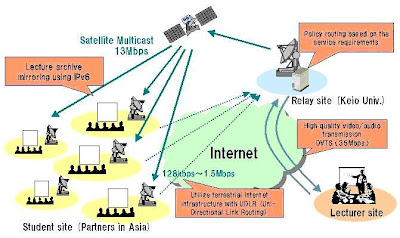
Application Configuration:
Three points in application design:
1) The stream can be multicast so that we can deliver lecture stream to multiple partners in Asia 2) The stream can be delivered to places without existing Internet infrastructure and
3) Interactive session based on student site's Internet connection is possible.

DVTS (Digital Video Transport System, RFC3189) or Polycom (video conferencing system) has been chosen for the connection between the lecturer site and the gateway site, and Windows Media Player or VIC (VIdeo Conference Tool) / RAT (Robust Audio Tool) for the connection between the gateway site and the student site. Various applications are being used such as VIC/RAT, Internet Relay Chat, Bulletin Board, MSN Messenger for the feedback from the student site to the lecturer site. The student site can decide which application they will use based on their Internet infrastructure.

Importance in developing countries
This is a call for a "Grand Challenge" project for achieving truly global connectivity. For over a decade, this project has hypothesized that the Internet could raise the quality of life in developing nations. Internet infrastructure is rapidly growing in Nepal. Growth in Information and Communication Technology would definitely improve the education quality. This is the age of globalization. So world’s education standards must globalize. Such projects have major contribution to globalize world’s education standards by conducting online live education which includes technologies of developed countries and share different countries education standards.
This is not to say the activity of the past decade has been a waste. The project has demonstrated the value of the Internet and raised awareness. The United Nations and the administrations of nearly all nations have acknowledged the potential of the Internet. The way has been paved, and it is time to act on what we have learned.

References
http://www.soi.wide.ad.jp/
http://portal.unesco.org/